
Is It Safe to Get Botox While Breastfeeding? What Doctors Recommend
August 17, 2026
Microneedling vs Laser for Skin Texture and Pores: How to Choose Based on Your Skin Type
September 14, 2026
Nobody wakes up one morning to find a new decade written on their face. The aging process is quiet, cumulative, and remarkably predictable – which is exactly what makes it manageable. At Tatoyan MD Medspa, our physician-led team spends every day looking at faces in every stage of this timeline, and the pattern is consistent: the skin aging process follows a schedule, and the people who age most gracefully are simply the ones who learned to work with that schedule instead of reacting to it a decade late.
This guide walks through the aging process decade by decade – what is happening in the dermis in your 20s, why your 30s feel like the first real shift, what accelerates in your 40s, why the 50s bring the steepest structural change, and what the aging process looks like from the 60s onward. You will learn which changes are intrinsic (genetically programmed), which are extrinsic (earned through sun, stress, and lifestyle), and where medical aesthetics can genuinely intervene.
Understanding the aging process is not about chasing a face you had at 22. It is about making informed, well-timed decisions so that your skin ages the way it was always meant to – slowly, evenly, and on your terms.
What Is the Skin Aging Process? A Physician’s Overview
The skin aging process is the gradual decline in the skin’s ability to renew, repair, and support itself. It unfolds across every layer of the skin and the structures beneath it, and dermatologists divide it into two distinct categories that behave very differently.
Intrinsic vs. Extrinsic Aging
Intrinsic aging is the biological aging process written into your genes. It begins around your mid-20s, moves at a slow and steady pace, and produces fine lines, thinning skin, and gradual volume loss. Nobody escapes intrinsic aging – but for most people it accounts for a surprisingly small share of what they see in the mirror.
Extrinsic aging – often called premature aging or photoaging – is the accelerated aging process caused by the outside world: ultraviolet radiation, pollution, smoking, sugar, alcohol, poor sleep, and chronic stress. It is responsible for the majority of sagging skin, deep wrinkles, age spots, and loss of skin elasticity that people bring into our office. The American Academy of Dermatology notes that while the natural aging process cannot be changed, this second, environmental type of aging can be meaningfully slowed through preventive habits. You can read their full guidance on reducing premature skin aging.
This distinction matters enormously. If most of the visible aging process is extrinsic, then most of it is modifiable – and prevention becomes the single highest-return investment you can make in your skin.
The Three Layers Where the Aging Process Unfolds
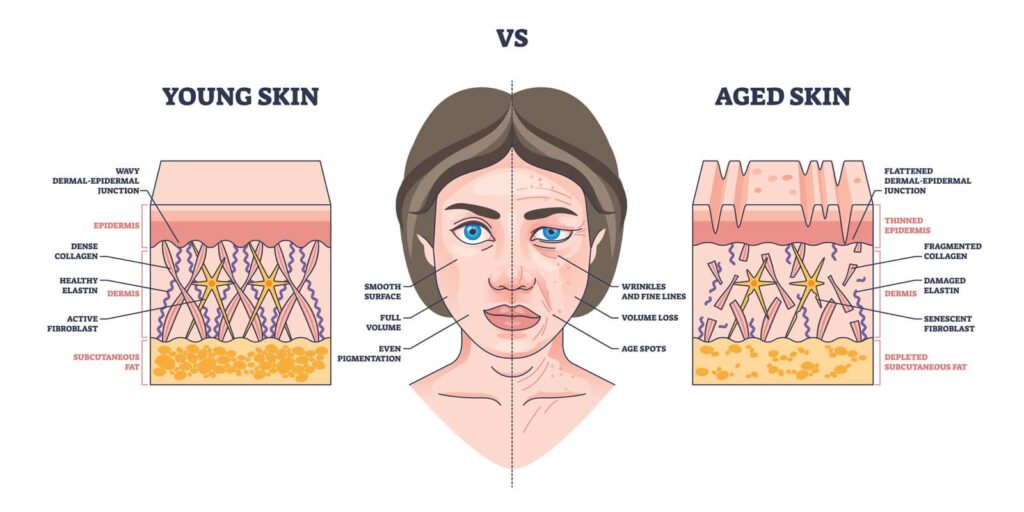
- Epidermis (surface): Cell turnover slows, the barrier weakens, and pigment cells become erratic. This is where dullness, dryness, and dark spots live.
- Dermis (structure): Collagen and elastin degrade. This is where wrinkles, laxity, and crepiness originate – and where the aging process does most of its real work.
- Subcutaneous fat and bone: Fat pads shrink and migrate downward; facial bone resorbs. This is why the aging process eventually changes your shape, not just your surface.
Treating only the top layer while the deeper layers change is the most common mistake we correct at Tatoyan MD Medspa. A truly effective plan addresses the aging process at every level simultaneously.
The Science Behind the Aging Process: Collagen, Elastin, and Cell Turnover
Collagen Loss Is the Engine of the Aging Process
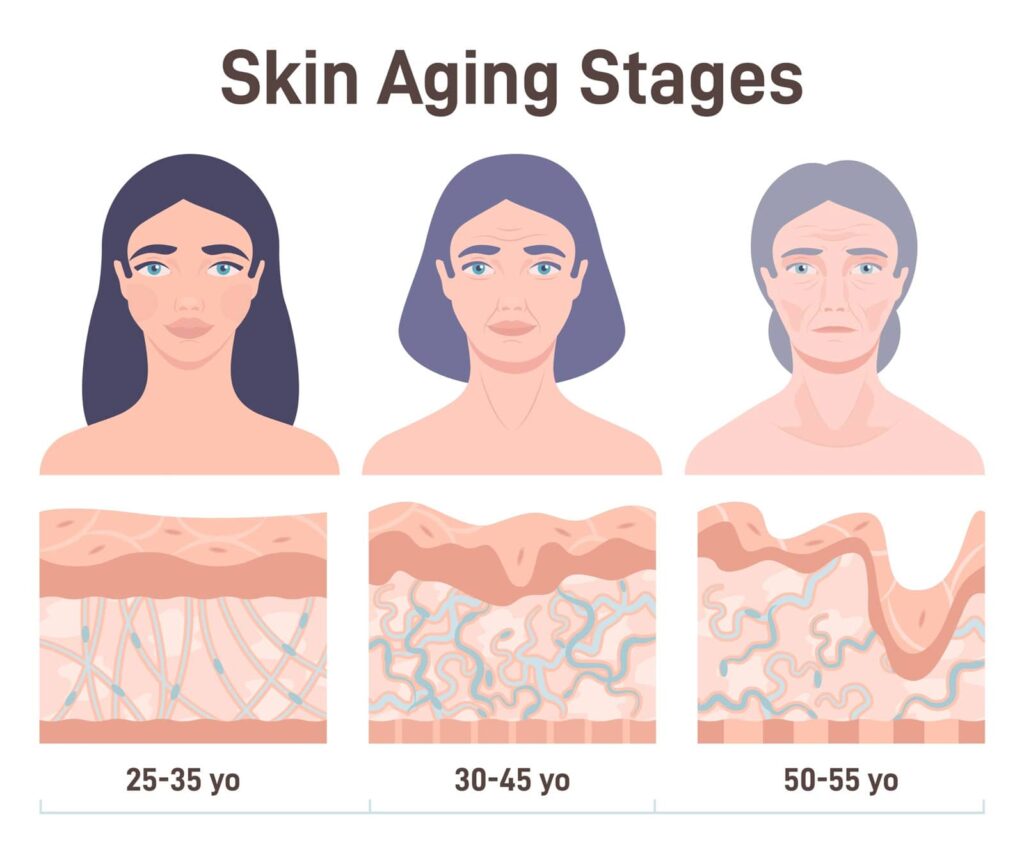
Collagen is the protein scaffolding that keeps skin firm, thick, and resilient. Beginning in the mid-20s, most people lose roughly 1% of their dermal collagen per year. That single statistic explains more about the aging process than almost any other: the loss is invisible for years, then crosses a threshold where the skin can no longer hold its own architecture.
Compounding this, the collagen your body does produce becomes progressively lower in quality – more fragmented, less organized, and less capable of springing back.
Elastin, Hyaluronic Acid, and the Hydration Decline
Elastin gives skin its snap. Unlike collagen, elastin is barely replenished in adulthood, so damage accumulates permanently. Sun exposure degrades it faster than any other factor, which is why the aging process looks dramatically different on sun-exposed cheeks than on protected skin under the arm.
Hyaluronic acid – the molecule that binds water in the dermis – also declines steadily. Less hyaluronic acid means less plumpness, more visible fine lines, and a duller light reflection off the skin. Much of what people describe as “tired-looking skin” is simply the hydration arm of the aging process.
Slowing Cell Turnover
In your 20s, skin cells renew roughly every 28 days. By your 50s, that cycle can stretch to 45–60 days or longer. Dead cells linger, texture roughens, and the complexion loses its glow. The National Institute on Aging’s overview of skin care and aging documents how the outer layer becomes thinner, paler, and less elastic over time.
Bone Resorption and Fat Pad Migration
The most underappreciated part of the facial aging process is skeletal. The orbital rims widen, the midface skeleton retrudes, and the jawline loses projection. Meanwhile, superficial fat compartments descend. The result is the “deflate and descend” pattern that defines the aging process from the 40s onward – and it is the reason surface skincare alone stops being sufficient.
The Aging Process in Your 20s: Prevention Is the Entire Strategy
What Is Happening Beneath the Surface
Your 20s are the last decade in which the aging process is genuinely silent. Collagen production peaks in the early 20s and begins its slow decline around age 25. Cell turnover is still fast, the barrier is intact, and the skin recovers from insults quickly.
But invisible does not mean inactive. UV damage accumulated in this decade is what surfaces as pigmentation and texture change 15 years later. The aging process in your 20s is essentially a deposit account – you are either making deposits or withdrawals.
Visible Signs in the 20s
- Faint expression lines that appear only during movement
- Occasional dullness from slowing turnover
- Early sun freckling on the cheeks, nose, and chest
- Under-eye hollowing in genetically predisposed individuals
What to Prioritize in Your 20s
- Daily broad-spectrum SPF 30+. The FDA’s consumer guidance on sunscreen and sun protection remains the single most evidence-backed anti-aging intervention available.
- A retinoid, introduced gradually, to support collagen synthesis before you need it.
- Antioxidant serum (vitamin C) each morning to neutralize free radicals.
- Preventive neuromodulator in small doses for those with strong expression lines – treating a line before it etches into the dermis is far easier than erasing it later.
- Consistency over intensity. The aging process rewards small daily habits, not occasional dramatic interventions.
The Aging Process in Your 30s: The First Visible Shift
This is the decade most people first say the words “something changed.” The aging process has not accelerated dramatically – it has simply crossed the visibility threshold.
Structural Changes in the 30s
Cumulative collagen loss now measures around 10%. Fine lines that once appeared only with expression begin to linger at rest. The fat pad under the eye starts to thin, and the tear trough deepens. Skin tone becomes less even as sun-induced pigmentation from earlier decades surfaces.
For many women, pregnancy and hormonal fluctuation add melasma to the picture, and the postpartum period often coincides with a noticeable acceleration in how the aging process presents.
What You Will Typically Notice
- Persistent forehead and glabellar (frown) lines at rest
- Early crow’s feet
- Loss of the “bounce back” quality after a late night
- Enlarged-appearing pores from reduced dermal support
- Dryness and slower healing from breakouts
Recommended Interventions in Your 30s
- Neuromodulators (Botox and similar) to soften dynamic lines before they become static
- Medical-grade chemical peels or microneedling to accelerate turnover and stimulate collagen
- Targeted hyaluronic acid filler for early tear trough or temple volume loss
- Prescription-strength retinoid and pigment-correcting actives
- Radiofrequency-based skin tightening as a maintenance strategy against the aging process
At Tatoyan MD Medspa, the 30s are our favorite decade to begin structured treatment – early intervention produces natural results that never look “done.”
The Aging Process in Your 40s: Structure Starts to Move
The 40s are when the aging process shifts from a surface story to a structural one. Collagen loss is now approaching 20–25% of your peak, and elastin damage is largely irreversible without intervention.
The Deflate-and-Descend Pattern
Facial fat pads do not simply shrink – they migrate. The midface volume that once sat high on the cheekbone slides downward, creating nasolabial folds and the first hint of jowling. Simultaneously, bone resorption around the orbital rim and jaw removes the scaffolding that held everything in place. This dual process is the defining signature of the aging process in the 40s.
Perimenopause Enters the Picture
For many women, perimenopause begins in the early-to-mid 40s. Fluctuating estrogen directly affects dermal collagen density, sebum production, and hydration – which is why the aging process can feel like it accelerates suddenly rather than gradually during this window.
Common Concerns in the 40s
- Nasolabial folds and marionette lines
- Early jowling and softening of the jawline definition
- Persistent horizontal neck lines and neck laxity
- Hyperpigmentation and sun spots becoming prominent
- Under-eye hollowing with skin crepiness
- Thinning hair density along the part line
Treatment Priorities for the 40s
- Volume restoration with strategically placed dermal fillers – replacing what was lost rather than adding what was never there
- Collagen-stimulating treatments such as microneedling with radiofrequency
- Body and skin tightening technologies for the neck, jawline, and abdomen
- Lumecca IPL for the sun spots, freckling, and vascular redness that surface in this decade
- Hair restoration, including Alma TED and PRP-based approaches, as follicular thinning becomes part of the visible aging process – you can learn more on our Alma TED service page
The Aging Process in Your 50s: Menopause and the Collagen Cliff
If the 40s are a slope, the 50s can feel like a cliff. Research consistently shows that women lose a substantial proportion of their remaining dermal collagen – commonly cited at roughly 30% within the first five years after menopause – before the rate settles into a slower annual decline.
This is the most consequential inflection point in the entire aging process, and it is also the least discussed.
Why Menopause Reshapes the Aging Process
Estrogen supports collagen synthesis, hyaluronic acid production, sebaceous activity, and wound healing. When estrogen falls, all four decline at once. The result is a compound effect: skin becomes simultaneously thinner, drier, less elastic, and slower to repair. Many patients describe the change as their skin “becoming a different skin.”
What Changes in the 50s
- Marked laxity along the jawline and neck
- Deepened static wrinkles that no longer soften with hydration
- Persistent dryness and a compromised moisture barrier
- Increased skin sensitivity and reactivity
- More prominent age spots and uneven tone
- Crepey skin and visible thinning on the hands, chest, and décolletage
- Loss of firmness through the cheeks and temples
- Noticeable hair thinning and reduced density
Treatment Priorities for the 50s
- Barrier repair first. Aggressive treatments on a compromised barrier backfire. Restoring lipid balance is step one.
- Combination therapy. No single modality addresses the aging process at this stage – layering energy-based tightening, injectables, and resurfacing produces results that no one treatment can.
- Evolve Transform for the arms, abdomen, and thighs, where the aging process affects contour and firmness rather than surface texture.
- Full-face assessment. Chasing individual wrinkles in the 50s produces an unbalanced result. The aging process is global by now, and treatment planning must be too.
- Medical oversight. This is where physician-led care matters most – hormonal, dermatologic, and aesthetic factors all intersect.
The Aging Process in Your 60s and Beyond
The good news about the aging process after 60 is that its rate slows considerably. The dramatic hormonal transition is complete, and change becomes gradual again.
What the Aging Process Looks Like After 60
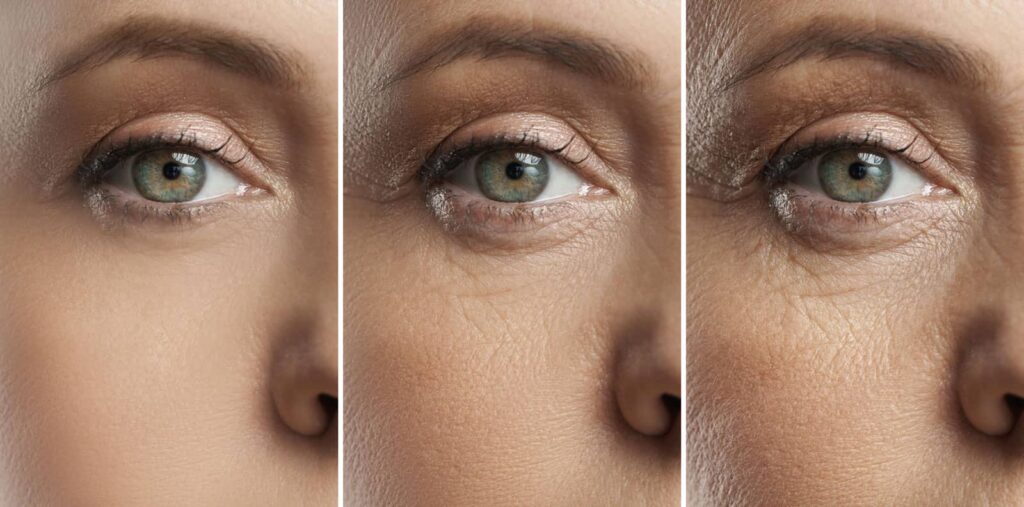
- Skin thinning becomes pronounced; the dermis may be 20–30% thinner than at age 20
- Blood vessel fragility increases, leading to easier bruising
- Sweat and oil production drop, causing persistent dryness and itch
- Wound healing slows meaningfully
- Elastosis – the yellowed, leathery quality of long-term sun damage – becomes visible on the chest and neck
- Bone resorption in the jaw and orbit reaches its most advanced stage
Goals Shift from Reversal to Optimization
At this stage, the most rewarding approach to the aging process is quality-focused rather than reversal-focused: improving skin health, hydration, tone, and comfort. Gentle collagen stimulation, conservative volume restoration, medical-grade skincare, and consistent photoprotection deliver results that look appropriate and refreshed rather than artificially altered.
Skin cancer screening also becomes non-negotiable. Decades of accumulated UV exposure make regular dermatologic evaluation an essential part of managing the aging process responsibly.
Lifestyle Factors That Accelerate the Aging Process
Roughly 80–90% of visible facial aging is attributed to extrinsic factors rather than chronology. Which means the aging process is, to a remarkable degree, negotiable.
Ultraviolet Radiation
The single largest accelerant. UVA penetrates to the dermis and destroys collagen and elastin directly. Daily sunscreen is not a cosmetic preference – it is the foundation of every credible plan to slow the aging process.
Smoking and Vaping
Nicotine constricts dermal blood vessels and reduces oxygen delivery. Smokers show measurably deeper wrinkling and sallower tone at every age.
Sugar and Glycation
Excess dietary sugar drives glycation, where sugar molecules bind to collagen fibers and stiffen them. Glycated collagen is brittle and cannot be repaired – a quiet but powerful contributor to the aging process.
Sleep Deprivation
Skin repair peaks during deep sleep. Chronic short sleep elevates cortisol, which directly suppresses collagen production and accelerates the aging process from the inside.
Chronic Stress and Alcohol
Sustained cortisol degrades collagen; alcohol dehydrates tissue and dilates capillaries. Both compound every other factor listed here.
Pollution and Blue Light
Particulate matter generates free radicals at the skin surface. An antioxidant serum plus a mineral SPF offers meaningful defense against this environmental arm of the aging process.
Decade-by-Decade Summary of the Aging Process
| Decade | Primary Biological Change | Most Visible Signs | Highest-Value Intervention |
| 20s | Collagen production peaks, then begins ~1%/year decline | Dynamic expression lines, early sun freckling | SPF, retinoid, antioxidants, preventive neuromodulator |
| 30s | ~10% cumulative collagen loss; turnover slows | Static forehead lines, crow’s feet, uneven tone | Neuromodulators, microneedling, peels, early filler |
| 40s | Fat pad descent, bone resorption, perimenopause | Nasolabial folds, jowling, neck laxity, pigment | Volume restoration, RF microneedling, laser, hair restoration |
| 50s | Menopausal collagen cliff (~30% in 5 years) | Marked laxity, dryness, deep static wrinkles | Barrier repair plus combination energy and injectable therapy |
| 60s+ | Rate slows; thinning and elastosis dominate | Thin, fragile, dry skin; advanced volume loss | Skin-quality optimization, conservative volume, screening |
Two Tatoyan MD Medspa Treatments Built for the Aging Process
Lumecca IPL: Correcting the Pigment Signature of the Aging Process
Every year of sun exposure leaves a record, and by the 30s and 40s that record surfaces as brown spots on the face, chest, hands, and arms – the most recognizable visual shorthand for the aging process. Lumecca is the most powerful intense pulsed light (IPL) platform available for treating pigmented and vascular lesions, working through selective photothermolysis: a calibrated pulse of light is absorbed by the pigment or blood vessel causing the discoloration, leaving surrounding tissue untouched. It clears age spots, sun damage, freckling, facial telangiectasias, poikiloderma, and rosacea redness – and because it targets the aging process at the layer where pigment actually lives, most patients see meaningful clearance in 1–3 sessions rather than the 4–6 typical of standard IPL.
Treatment is not limited to the face. Lumecca can be used anywhere on the body, with the neck, décolletage, hands, arms, and legs among the most common areas, since those are precisely where sun exposure accelerates the aging process most visibly. Expect a brief snap of light and warmth, with redness settling within an hour; pigmented spots darken over 24–48 hours and flake away across the following week, leaving noticeably more even tone. Because photoprotection is central to controlling the aging process, we ask patients to avoid excessive sun and tanning for a month beforehand and to stay diligent with SPF afterward.
Evolve Transform: Skin Strengthening Against the Structural Aging Process
Pigment is only half the story – the other half of the aging process is structural, involving skin that has lost firmness, fat that resists diet and exercise, and the dimpling of cellulite that appears as connective tissue weakens. Evolve Transform, part of InMode’s Evolve system, addresses that structural side of the aging process without surgery or downtime. Six hands-free applicators combine radiofrequency energy with negative vacuum suction to heat and redistribute subcutaneous fat while simultaneously remodeling the overlying skin. That dual action matters, because the aging process affects fat and skin together – treating one and ignoring the other leaves results half-finished.
Evolve Transform works best on the arms, abdomen and surrounding areas, and the thighs and legs, delivering body sculpting, smoother cellulite, fat reduction, firmer skin, and more toned musculature across a handful of short sessions. It suits patients at a stable weight with localized pockets of fat and cellulite rather than significant weight to lose, and it is safe for every skin type, with body temperature monitored in real time throughout. For many patients past 40 the answer is both treatments: Lumecca resets the surface record of the aging process while Evolve Transform rebuilds the structure underneath it.
How Tatoyan MD Medspa Approaches the Aging Process
Physician-led care changes what is possible. Our approach to the aging process rests on four principles:
- Assess before treating. We evaluate skin quality, volume, laxity, and pigment as separate variables, because the aging process affects each on its own timeline.
- Sequence correctly. Tightening before volumizing, barrier repair before resurfacing – order matters as much as technique.
- Match intensity to decade. A treatment plan appropriate for a 34-year-old is rarely appropriate for a 58-year-old, even for the same visible concern.
- Build maintenance in. The aging process does not pause after a treatment. Sustainable results come from planned intervals, not one-time procedures.
Every consultation at Tatoyan MD Medspa begins with mapping where you actually are in the aging process – which is frequently different from where the calendar suggests.
Frequently Asked Questions About the Skin Aging Process
1. At what age does the skin aging process actually begin?
Biologically, the aging process begins in the mid-20s, when collagen production peaks and starts declining at roughly 1% per year. Most people do not see changes until their early-to-mid 30s, because the skin has enough reserve to mask early losses. This gap between when the aging process starts and when it becomes visible is precisely why prevention in the 20s is so effective – you are protecting reserve you still have.
2. Can you reverse the skin aging process, or only slow it down?
Both, partially. Certain elements of the aging process are genuinely reversible: pigmentation, texture, hydration, and a meaningful degree of collagen density can be improved with retinoids, resurfacing, and collagen-stimulating treatments. Other elements – elastin damage, bone resorption, and glycated collagen – cannot be restored to their original state, though their appearance can be compensated for. A realistic goal is slowing the aging process substantially while reversing the components that are reversible.
3. Why did my skin change so suddenly in my 50s?
Menopause. The decline in estrogen simultaneously reduces collagen synthesis, hyaluronic acid production, oil production, and repair capacity. Because these four systems fail together rather than sequentially, the aging process feels abrupt even though the underlying trajectory was already in motion. This is a physiological event, not a personal failing – and it responds well to a treatment plan built specifically for post-menopausal skin.
4. How much of the aging process is genetic versus lifestyle?
Research consistently attributes roughly 80–90% of visible facial aging to extrinsic factors – primarily sun exposure – with genetics governing the remaining intrinsic portion. Genetics determine when the intrinsic aging process begins and how your face is structured; lifestyle determines how fast the visible aging process moves. Two people with identical genetics and different sun habits will not look the same at 55.
5. What is the single most effective thing I can do to slow the aging process at any age?
Daily broad-spectrum sunscreen, without exception. No serum, device, or injectable outperforms consistent photoprotection for slowing the aging process, and it is the only intervention that works equally well at 22 and 62. Layering a retinoid and an antioxidant on top of that foundation covers the large majority of what at-home care can accomplish – professional treatments then address what topical products structurally cannot.
The Bottom Line on the Skin Aging Process
The aging process is not a single event you can outrun. It is a sequence – predictable, staged, and, at every point along the way, responsive to intervention. Your 20s are for prevention. Your 30s are for early correction. Your 40s are for structural support. Your 50s are for rebuilding what hormones took. Your 60s and beyond are for optimizing quality and comfort.
The patients who look best are almost never the ones who did the most. They are the ones who did the right things at the right time, guided by someone who understood where they actually stood in the aging process.
If you would like a professional assessment of where you are on that timeline – and a plan built for your decade rather than a generic protocol – the team at Tatoyan MD Medspa is here to help. Schedule a consultation and let’s map your aging process together.