What Is the Evolve X Treatment and What Does It Do?
July 20, 2026
Is It Safe to Get Botox While Breastfeeding? What Doctors Recommend
August 17, 2026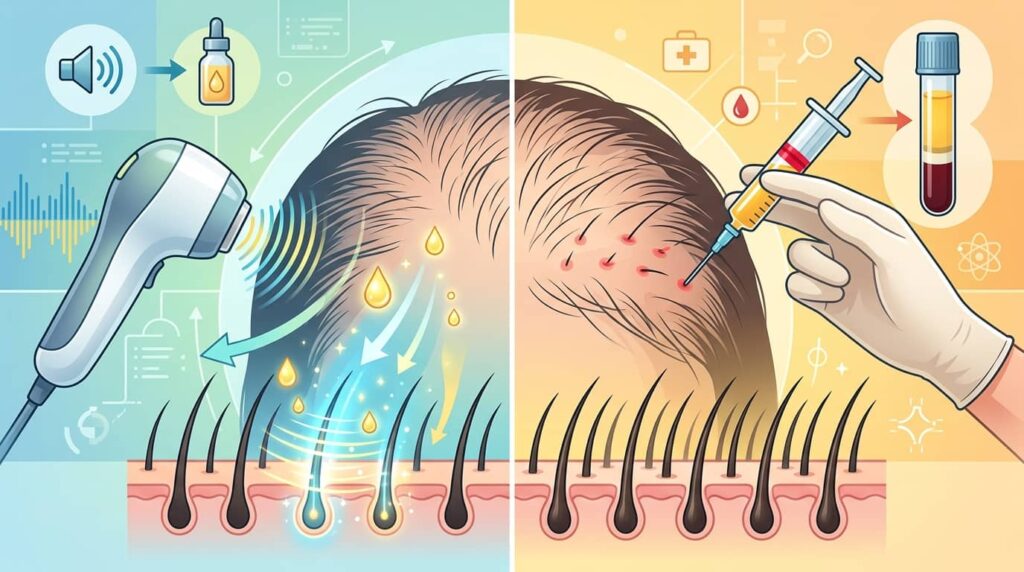
Losing your hair can feel deeply personal, and when you start researching solutions, two names come up again and again: Alma TED and PRP. If you have found yourself weighing Alma TED vs PRP for thinning hair, you are asking exactly the right question. These two non-surgical hair restoration treatments both aim to wake up sluggish follicles and encourage regrowth, but they do it in very different ways, one with needles and your own blood, the other completely needle-free.
So in the Alma TED vs PRP matchup, which is actually more effective, and which is less painful? At Tatoyan MD Medspa, our physician-led team performs both treatments, which means we can give you an honest, balanced comparison rather than a one-sided sales pitch. In this in-depth guide, we break down how each treatment works, what the science says, how much discomfort to expect, and how to decide which option fits your goals. Let’s settle the Alma TED vs PRP debate with facts.
Understanding the Alma TED vs PRP Debate
Before we dive into the details of the Alma TED vs PRP comparison, it helps to understand why this particular pairing generates so much interest. Both are popular, non-surgical hair restoration options that avoid the cost and recovery of a hair transplant. Both work by stimulating your hair follicles rather than replacing them. And both have loyal followings among patients and providers alike.
The core of the Alma TED vs PRP conversation usually comes down to three things: effectiveness, comfort, and convenience. PRP has a longer clinical track record, while Alma TED offers a completely painless, needle-free experience. Choosing between them is rarely about which treatment is “better” in the abstract, and far more about which is better for you. That is the lens we will use throughout this Alma TED vs PRP guide.
What Is Alma TED Hair Restoration?
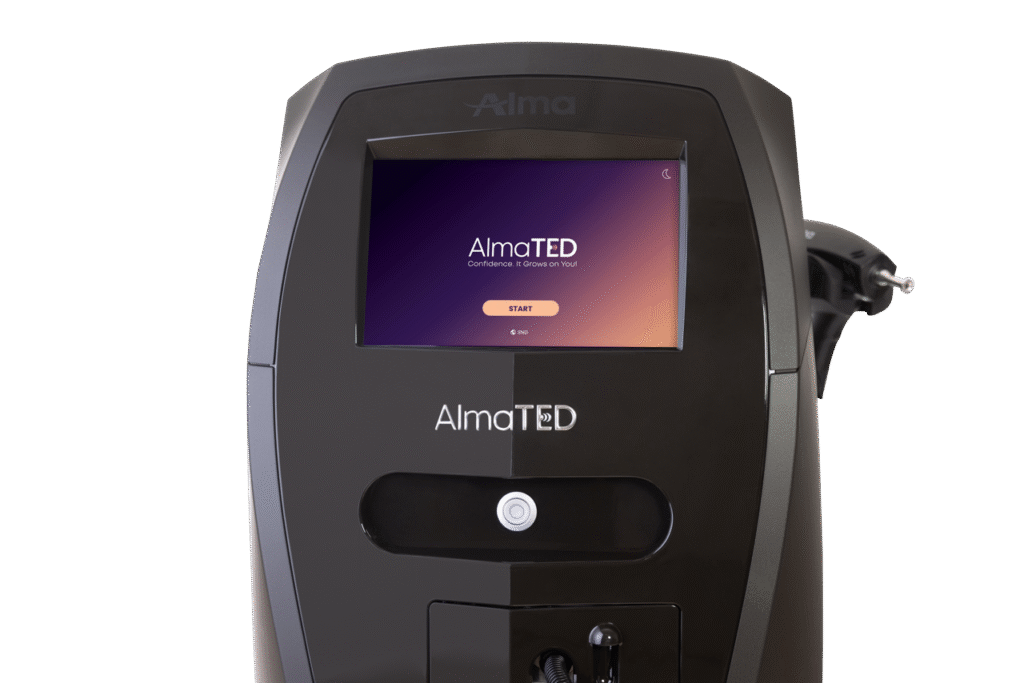
To make sense of the Alma TED vs PRP question, let’s start with the newer of the two. Alma TED, short for TransEpidermal Delivery, is a non-invasive, needle-free hair restoration treatment that uses acoustic sound waves and gentle air pressure to drive a nourishing serum deep into the scalp, no injections required.
How Alma TED Works
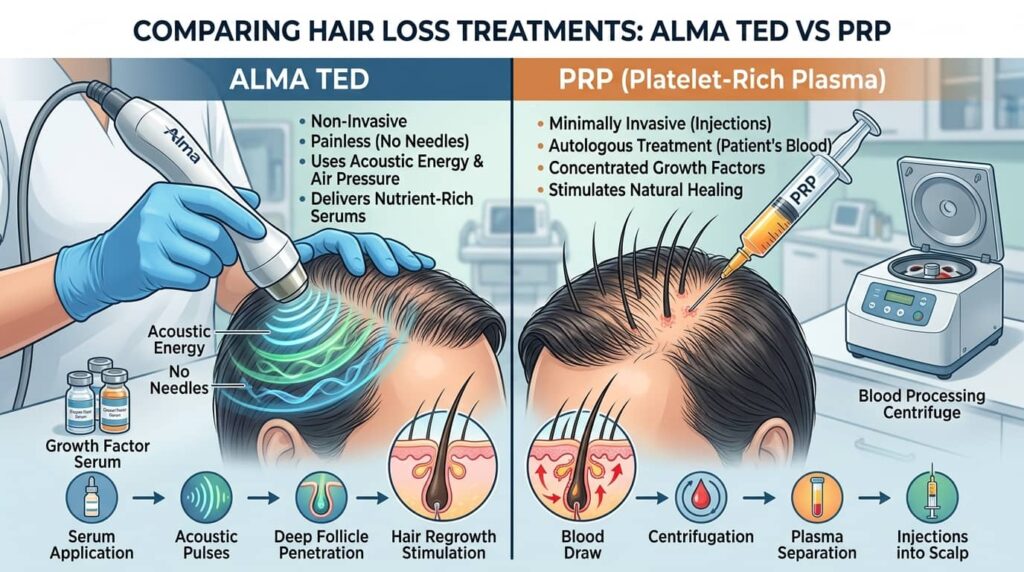
Alma TED relies on low-frequency ultrasound technology paired with air-pressure delivery. Here is the simplified version of what happens during a session:
- A specialized TED+ hair care serum, rich in growth factors and peptides designed to support hair health, is applied to the scalp.
- The Alma TED handpiece uses ultrasonic sound waves and air pressure to temporarily open microscopic pathways in the skin’s surface.
- These pathways allow the serum to penetrate down toward the hair follicles without any needles, incisions, or blood draw.
- The improved delivery is thought to boost circulation to the scalp and nourish dormant follicles, encouraging thicker, healthier hair over time.
Because there are no needles involved, Alma TED is completely painless. This needle-free approach is one of the biggest reasons patients gravitate toward Alma TED in the Alma TED vs PRP decision, particularly if they are anxious about injections or the sight of blood. It is often the deciding factor when patients first begin researching Alma TED vs PRP online. You can learn more about this treatment on our Alma TED hair restoration service page.
Alma TED Benefits
When patients ask us about Alma TED in the context of the Alma TED vs PRP comparison, these are the advantages that stand out:
- Completely pain-free with no needles and no blood draw
- No downtime, so you can return to your day immediately
- Fast, comfortable sessions, usually around 20 to 30 minutes
- Non-invasive, which means no risk of injection-site bruising or infection
- Well-suited to needle-averse patients and those in the early stages of hair thinning
- May show visible improvement in as little as a couple of months for many patients
Alma TED is often described as an excellent option for early-stage hair loss, preventive care, and anyone who simply wants the most comfortable experience possible. For many of these patients, the comfort advantage alone tips the Alma TED vs PRP scales.
What Is PRP Hair Restoration (Platelet-Rich Plasma)?
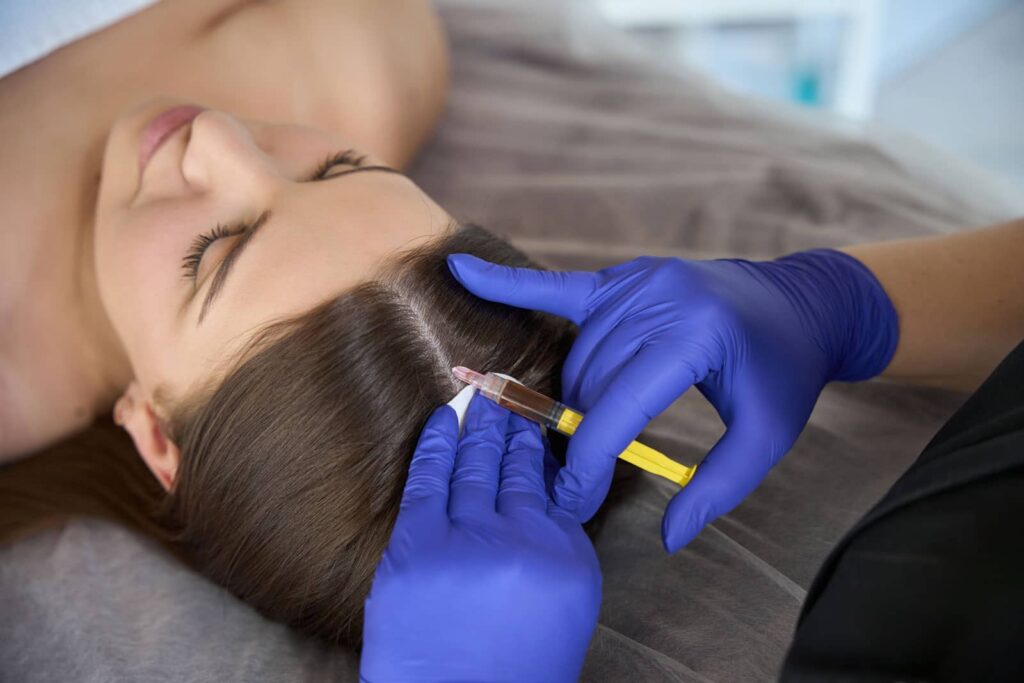
The other half of the Alma TED vs PRP equation is PRP, or platelet-rich plasma therapy, a regenerative treatment that has been used in aesthetics and medicine for well over a decade.
How PRP Therapy Works
PRP harnesses the healing power of your own blood. The process for platelet-rich plasma hair restoration looks like this:
- A small sample of your blood is drawn, much like a routine lab test.
- The sample is placed in a centrifuge, which spins it to separate and concentrate the platelets.
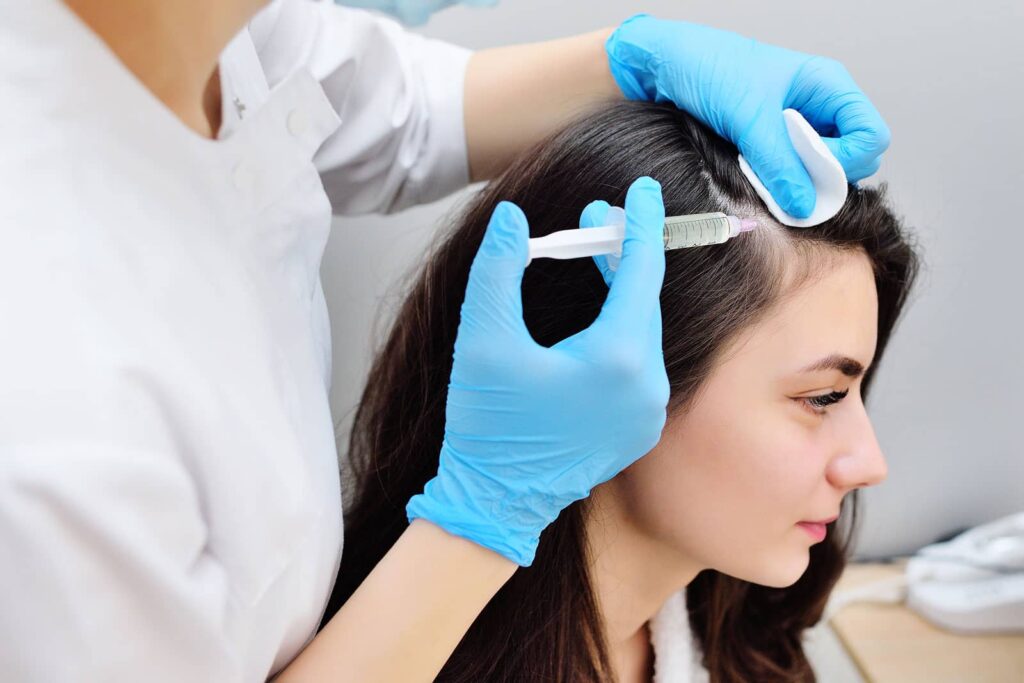
- The resulting platelet-rich plasma, packed with growth factors, is then injected into the scalp in the areas of thinning.
- These concentrated growth factors act on the stem cells in the hair follicle, stimulating regrowth, prolonging the growth (anagen) phase, and encouraging new blood vessel formation.
Because PRP uses your body’s own biological material, there is essentially no risk of an allergic reaction to the plasma itself. The trade-off, and a key point in the Alma TED vs PRP discussion, is that PRP requires needles: both for the blood draw and for the scalp injections. This is precisely the contrast that defines the Alma TED vs PRP comparison, one treatment is needle-free, the other is not.
PRP Benefits
PRP brings its own compelling advantages to the Alma TED vs PRP comparison:
- A long clinical track record, with more than a decade of use for hair restoration
- Robust scientific support, especially for androgenetic alopecia (genetic pattern hair loss)
- Uses your own blood, minimizing the risk of allergic reaction
- Effective for many patients with a range of hair loss patterns
- Established treatment protocols refined over years of clinical experience
Multiple peer-reviewed studies support PRP’s role in hair restoration. Research published through the National Institutes of Health notes that both men and women with androgenetic alopecia have shown positive results after PRP, including regrowth, increased hair density, and improved quality of life (National Library of Medicine). This depth of evidence is a major reason PRP holds its own in the Alma TED vs PRP comparison.
Alma TED vs PRP: How Do They Compare?
Now that you understand each treatment individually, let’s put them side by side. This is where the Alma TED vs PRP comparison gets practical. The table below summarizes the Alma TED vs PRP comparison across the factors that matter most to patients.
| Factor | Alma TED | PRP (Platelet-Rich Plasma) |
| Technology | Ultrasound sound waves + air pressure + serum | Concentrated platelets from your own blood |
| Needles? | No, completely needle-free | Yes, blood draw + scalp injections |
| Pain level | Painless | Mild discomfort; numbing often used |
| Blood draw? | No | Yes |
| Downtime | None | Minimal (avoid washing hair ~24 hours) |
| Session length | ~20–30 minutes | ~45–60 minutes |
| Clinical track record | Newer treatment | 10+ years, well studied |
| Best for | Needle-averse, early thinning, comfort | Genetic hair loss, evidence-backed results |
This Alma TED vs PRP snapshot makes the core trade-off clear: Alma TED wins on comfort and convenience, while PRP wins on clinical evidence and track record. But the details are where the real decision lives, so let’s dig into the two questions you came here to answer.
Alma TED vs PRP: Which Is More Effective for Hair Loss?
Effectiveness is usually the first thing people want settled in the Alma TED vs PRP debate, and it is also the most nuanced. The honest answer is that both treatments can be effective, but they are supported by different amounts of evidence.
The Clinical Evidence for PRP
When it comes to proven results, PRP currently holds the edge in the Alma TED vs PRP comparison, simply because it has been studied far more extensively. This research gap is central to understanding Alma TED vs PRP on effectiveness. Platelet-rich plasma has been researched for hair restoration for many years, with a particular focus on androgenetic alopecia, the most common form of genetic hair loss.
A comprehensive review of the evidence found that the majority of studies demonstrate PRP is effective at increasing hair density and thickness in patients with androgenetic alopecia, though researchers also note that variability in how PRP is prepared can influence outcomes (National Library of Medicine). In other words, PRP works, but consistency of technique matters, which is another reason to choose an experienced, physician-led provider.
For context, it helps to remember that the only medications formally approved by the U.S. Food and Drug Administration for pattern hair loss are minoxidil and finasteride. The American Academy of Dermatology emphasizes that early diagnosis and treatment of hereditary hair loss can help prevent it from worsening (American Academy of Dermatology). PRP and Alma TED are both used as complementary, in-office options alongside, or in place of, those baseline therapies.
The Emerging Results for Alma TED
Alma TED is the newer contender in the Alma TED vs PRP matchup, so it does not yet have the same depth of long-term clinical research behind it. This is worth keeping in mind whenever you read confident, black-and-white claims about Alma TED vs PRP. That said, patient results have been encouraging. Many people notice reduced shedding and improved hair density after a series of Alma TED treatments, with some seeing visible improvement in a matter of a couple of months, occasionally faster than they might with PRP.
Alma TED tends to shine for patients in the earlier stages of thinning and for those focused on prevention and scalp health. For more advanced or long-standing genetic hair loss, the deeper, growth-factor-driven mechanism of PRP, backed by more research, may offer a stronger track record.
The verdict on effectiveness: In the Alma TED vs PRP comparison, PRP currently has more robust clinical evidence, especially for genetic hair loss, while Alma TED delivers promising, comfortable results that are particularly appealing for early intervention. Neither is a magic bullet, and both work best when started early and maintained over time. That nuance is why the Alma TED vs PRP answer is rarely one-size-fits-all.
Alma TED vs PRP: Which Is Less Painful?
If comfort is your top priority, this section may settle the Alma TED vs PRP question for you on its own. Of all the factors in the Alma TED vs PRP comparison, pain is where the two treatments differ most, and the difference is clear-cut.
Alma TED is the less painful option, hands down. Because it uses ultrasound sound waves and air pressure rather than needles, there is no blood draw and no injecting anything into your scalp. Most patients describe the sensation as a gentle warmth or mild pressure, nothing that would typically require numbing. For anyone who is needle-averse, squeamish about blood, or simply wants a stress-free appointment, this is a decisive factor in the Alma TED vs PRP decision.
PRP involves needles, both to draw your blood and to inject the plasma into the scalp. That means some patients experience mild discomfort, tenderness, or a pinching sensation during the injections. The good news is that this discomfort is usually manageable and short-lived, and most providers apply a topical numbing cream beforehand to keep you comfortable. After the session, you might notice temporary soreness, redness, or slight swelling at the injection sites, which typically resolves within a day or so.
To summarize the comfort side of the Alma TED vs PRP comparison:
- Alma TED: No needles, no blood draw, essentially painless
- PRP: Needles required, mild and manageable discomfort, often eased with numbing cream
If minimizing pain is your single biggest concern, Alma TED is the clear winner of this round of the Alma TED vs PRP debate, and for many needle-averse patients, that settles the Alma TED vs PRP question entirely.
Is Alma TED Better Than PRP?
Sooner or later, everyone researching this topic asks the blunt version of the question: is Alma TED better than PRP? It is arguably the heart of the entire Alma TED vs PRP debate. The honest, physician-led answer is that neither is universally better. They excel at different things, and the “winner” of the Alma TED vs PRP comparison depends entirely on what you value most.
Here is a straightforward way to settle whether Alma TED is better than PRP for you, and to cut through the noise in the Alma TED vs PRP comparison:
- Alma TED is better than PRP when comfort and convenience come first. It is completely needle-free and painless, has essentially no downtime, uses shorter appointments, and is a natural fit for needle-averse patients or those in the earlier stages of thinning. For this group, the Alma TED vs PRP choice is easy.
- PRP is better than Alma TED when clinical evidence carries the most weight. It has a longer track record, more published research, and particularly strong support for genetic pattern hair loss, using your own concentrated growth factors.
There is also an interesting mechanistic nuance in the Alma TED vs PRP discussion. Some providers point out that Alma TED’s acoustic energy may help disperse DHT (dihydrotestosterone), the hormone that drives pattern hair loss, from the scalp, a mechanism PRP does not share. PRP, in turn, floods the follicles with concentrated growth factors that Alma TED does not supply. In other words, the two treatments approach the same goal from different biological angles, which is part of why “is Alma TED better than PRP” rarely has a one-word answer, and why the Alma TED vs PRP comparison stays genuinely competitive.
The most useful reframe is this: in the Alma TED vs PRP decision, “better” is really about fit. When people ask whether Alma TED is better than PRP, the Alma TED vs PRP answer that actually helps is a personalized one. The better treatment is the one that matches your hair loss stage, your comfort tolerance, and your goals, and for some patients, the strongest plan combines both. A personalized consultation is the only reliable way to know which side of the Alma TED vs PRP comparison suits you.
Alma TED or PRP for Female Hair Loss
Female hair loss deserves its own section, because both the causes and the ideal treatment can differ from men’s. The Alma TED vs PRP answer is not always the same for women as it is for men. So when you are choosing between Alma TED or PRP for female hair loss, what should you know? The Alma TED vs PRP calculus shifts a bit for women.
Female pattern hair loss, also called female androgenetic alopecia, is the most common form of hair loss in women. It typically shows up as diffuse thinning across the crown and top of the scalp while the frontal hairline usually stays intact. But women’s hair loss is often multifactorial: hormonal shifts around menopause, postpartum shedding after childbirth, thyroid conditions, PCOS, iron deficiency, and stress-related telogen effluvium can all play a role. That is why, before weighing Alma TED or PRP for female hair loss, a proper scalp analysis and workup to identify the underlying cause matters so much.
PRP for female hair loss. PRP has meaningful research support in women specifically. A review of the literature on platelet-rich plasma for female androgenetic alopecia, published through the National Institutes of Health, found that PRP has been studied across multiple clinical trials in female patients with pattern hair loss (National Library of Medicine). For women with genetic thinning who are comfortable with injections, PRP is a well-established, evidence-backed choice in the Alma TED vs PRP comparison. This female-specific research is one reason PRP earns its place in the Alma TED vs PRP debate for women.
Alma TED for female hair loss. Alma TED is FDA-cleared for androgenetic alopecia, which includes female pattern hair loss, and its needle-free, no-downtime nature makes it especially appealing to women who want results without injections. It tends to perform well for early, diffuse thinning, postpartum shedding, and stress-related telogen effluvium, situations where the follicles are still active and simply need stimulation and support. For many women, this comfort factor tips the Alma TED vs PRP decision toward Alma TED.
When deciding on Alma TED or PRP for female hair loss, keep these points in mind as you weigh the Alma TED vs PRP options:
- Identify the cause first. Because women’s hair loss can stem from hormones, thyroid, or nutrition, treating the root cause alongside either option improves results.
- Both need active follicles. Neither Alma TED nor PRP can restore hair in areas of complete follicular loss or scarring, an important expectation to set.
- Comfort vs. evidence. In the Alma TED vs PRP decision for women, Alma TED wins on comfort while PRP offers a deeper female-specific research base.
- Combination is possible. Some women benefit from a plan that uses both treatments.
The bottom line on Alma TED or PRP for female hair loss: both are viable, and the best choice in the Alma TED vs PRP comparison depends on the cause of your thinning, your stage of hair loss, and your comfort preferences. A physician-led consultation is the smartest first step.
Effectiveness and pain are the headline issues, but real-life convenience also plays a big part in the Alma TED vs PRP decision. Here is how the two compare on logistics.
Downtime. Both treatments are considered low-downtime, but in the Alma TED vs PRP comparison, Alma TED has a slight edge. After Alma TED, you can generally resume all normal activities right away. After PRP, most providers recommend waiting about 24 hours before washing your hair and avoiding vigorous scalp activity briefly, along with the possibility of mild soreness.
Number of sessions. Neither treatment is a one-and-done fix, an important reality check in any Alma TED vs PRP discussion. PRP protocols often involve an initial series of monthly sessions followed by maintenance treatments spaced further apart. Published treatment frameworks describe initial monthly sessions during the first few months, then periodic maintenance over the year (National Library of Medicine). Alma TED is also typically performed as a series of sessions spaced roughly a month apart, with maintenance to preserve results. We break down exactly when to expect visible change in the dedicated Alma TED vs PRP results timeline below.
Alma TED vs PRP Results Timeline
One of the most practical questions in the whole Alma TED vs PRP conversation is simply: when will I actually see results? Neither treatment is instant, because hair grows on its own biological schedule, so setting realistic expectations is key. Understanding the Alma TED vs PRP results timeline up front helps you stay patient and consistent. Here is a general Alma TED vs PRP results timeline to guide you.
- First 2 to 4 weeks: Visible change is unlikely this early, but many patients notice reduced shedding, often the very first sign that a treatment is working. This is true on both sides of the Alma TED vs PRP comparison.
- 4 to 8 weeks: Alma TED patients frequently begin to see early visible improvement in this window, sometimes a bit sooner than with PRP. PRP patients often start noticing changes a few weeks after their second or third session.
- 3 to 6 months: This is where the fuller results emerge for both treatments, as your hair cycles through its natural growth phase, improved density, thickness, and overall scalp health become more apparent.
- Ongoing maintenance: Neither treatment is permanent. To sustain your gains, both Alma TED and PRP require periodic maintenance sessions, which your provider will schedule based on your response. This maintenance need applies equally to both sides of the Alma TED vs PRP comparison.
Here is the same Alma TED vs PRP results timeline in a side-by-side view:
| Timeframe | Alma TED | PRP |
| First 2–4 weeks | Reduced shedding possible | Reduced shedding possible |
| 4–8 weeks | Early visible improvement | Changes after 2nd–3rd session |
| 3–6 months | Fuller density and thickness | Fuller density and thickness |
| Maintenance | Periodic sessions to sustain | Periodic sessions to sustain |
The key takeaway from the Alma TED vs PRP results timeline is that both treatments reward patience and consistency. Whichever way your Alma TED vs PRP decision lands, Alma TED may hold a modest early-speed advantage for some patients, but with either option, the most meaningful results build over several months, and maintenance keeps them going. Individual results vary based on your age, the cause and stage of your hair loss, and how closely you follow your treatment plan.
Safety is understandably a major consideration, and here the Alma TED vs PRP comparison is reassuring on both sides, because both are well tolerated when performed by qualified professionals.
On the safety side of the Alma TED vs PRP comparison, here is what to know about each. Alma TED is non-invasive and needle-free, which eliminates the risks associated with injections, there is no wound, no blood exposure, and a very low risk of infection. Side effects are minimal, and most patients experience nothing more than possible temporary redness.
PRP is also considered very safe, in large part because it uses your own blood, so there is no risk of rejection or allergic reaction to a foreign substance. The most common side effects are mild and temporary: tenderness, redness, minor swelling, or slight bruising at the injection sites, all of which usually fade within a day.
The single most important safety factor in the Alma TED vs PRP decision is not the treatment itself, it is who performs it. Both treatments deliver the best and safest results in the hands of an experienced, medically supervised provider, which is exactly what you get at Tatoyan MD Medspa.
Alma TED vs PRP: Which Treatment Is Right for You?
By now you can see that the Alma TED vs PRP question does not have a single universal answer. The right choice depends on your priorities, your stage of hair loss, and your comfort level. Here is a simple way to think about it.
To make the Alma TED vs PRP choice more concrete, here are two quick profiles.
Choose Alma TED If You…
- Want a completely pain-free, needle-free experience
- Are anxious about needles, injections, or blood draws
- Are in the early stages of thinning or focused on prevention
- Prefer the fastest, most convenient appointment with zero downtime
- Want to improve overall scalp health and hair quality comfortably
Choose PRP If You…
- Prefer a treatment with a longer clinical track record and more research
- Are dealing with genetic pattern hair loss (androgenetic alopecia)
- Are comfortable with minor, manageable discomfort for evidence-backed results
- Want a regenerative approach that uses your own growth factors
Can You Combine Alma TED and PRP?
Here is a point many patients overlook in the Alma TED vs PRP debate: it does not always have to be either-or. In some cases, a provider may recommend using both treatments as part of a comprehensive hair restoration plan, leveraging PRP’s regenerative growth factors alongside Alma TED’s comfortable, needle-free delivery. Whether combining them makes sense for you is a conversation best had during a personalized consultation, and it is a reminder that Alma TED vs PRP need not be a strict competition at all.
Read more: Who Is the Ideal Candidate for Alma TED Hair Restoration
Why Choose Tatoyan MD Medspa for Alma TED vs PRP Hair Restoration
When you are weighing Alma TED vs PRP, the expertise of your provider matters just as much as the technology. In fact, provider skill can influence the Alma TED vs PRP outcome as much as the treatment you choose. Both treatments rely on precise technique, appropriate patient selection, and honest guidance, and that is where the Tatoyan MD Medspa difference comes in.
As a physician-led medical aesthetics practice, we offer both Alma TED and PRP, which means our recommendation is guided by your needs, not by which single treatment we happen to offer. When you visit us to explore the Alma TED vs PRP decision, you can expect:
- Medical oversight on every hair restoration plan
- Honest, balanced guidance on whether Alma TED, PRP, or a combination best suits your goals
- Customized protocols based on your stage of hair loss and comfort preferences
- A supportive, judgment-free environment where your questions are always welcome
Hair loss is personal, and choosing between Alma TED vs PRP should feel like a partnership, not a gamble. Our team is here to help you make a confident, well-informed decision.
Frequently Asked Questions About Alma TED vs PRP
1. Which is more effective, Alma TED vs PRP?
In the Alma TED vs PRP comparison, PRP currently has more extensive clinical evidence, particularly for genetic hair loss (androgenetic alopecia), because it has been studied for many years. Alma TED is newer but delivers promising results, especially for early-stage thinning and prevention. The most effective choice depends on your specific hair loss pattern and goals, which a consultation can help determine.
2. Which is less painful, Alma TED vs PRP?
Alma TED is the less painful option. It is completely needle-free, using ultrasound sound waves and air pressure instead of injections, so most patients feel little to nothing. PRP involves a blood draw and scalp injections, which can cause mild, manageable discomfort, though numbing cream is typically used to minimize it.
3. How long do results last with Alma TED vs PRP?
Neither treatment is permanent, and both require maintenance, an important expectation to set in any Alma TED vs PRP conversation. In the Alma TED vs PRP comparison, results from either option can last several months, after which maintenance sessions help preserve your hair gains. Your provider will recommend a maintenance schedule tailored to your response and the extent of your hair loss.
4. Is Alma TED or PRP better for early-stage hair loss?
For early-stage thinning and prevention, many patients find Alma TED especially appealing thanks to its painless, needle-free approach and quick sessions. PRP is often favored for more established genetic hair loss because of its stronger research base. In the Alma TED vs PRP decision, both can be valuable early, so a professional assessment is the best way to choose the right fit in the Alma TED vs PRP comparison for your situation.
5. Can I get both Alma TED and PRP together?
Yes, in some cases. Rather than treating the Alma TED vs PRP question as strictly either-or, some patients get the best of the Alma TED vs PRP comparison by using both, and some providers combine the two to take advantage of PRP’s regenerative growth factors and Alma TED’s comfortable delivery. Whether a combination plan is right for you should be discussed during a personalized consultation.
6. Is Alma TED or PRP better for female hair loss?
Both can help with female hair loss, and the Alma TED vs PRP answer for women depends on the cause. PRP has more female-specific research support, particularly for female pattern hair loss (androgenetic alopecia), while Alma TED is FDA-cleared for pattern hair loss and offers a needle-free, no-downtime experience many women prefer. Because women’s hair loss is often multifactorial, involving hormones, thyroid, or nutrition, the smartest first step in the Alma TED or PRP for female hair loss decision is a consultation to identify the underlying cause.
7. What does the Alma TED vs PRP results timeline look like?
With both treatments, reduced shedding is often the first sign within the first few weeks. In the Alma TED vs PRP results timeline, early visible improvement tends to appear around 4 to 8 weeks (sometimes slightly sooner with Alma TED), and fuller density develops over 3 to 6 months as your hair completes its growth cycle. Because neither is permanent, the Alma TED vs PRP results timeline also includes ongoing maintenance sessions to sustain your results.
Ready to Decide Between Alma TED vs PRP? Let’s Talk
At the end of the day, the Alma TED vs PRP decision comes down to what matters most to you. If your priority is a completely pain-free, needle-free experience, Alma TED is hard to beat. If you want the reassurance of a longer clinical track record for genetic hair loss, PRP may be the better fit. And for some patients, the ideal answer is a thoughtful combination of both.
At Tatoyan MD Medspa, our physician-led team performs both treatments and will give you honest, personalized guidance to help you regain fuller, healthier hair with confidence. Ready to move past the Alma TED vs PRP dilemma and find your best path forward? Contact Tatoyan MD Medspa today to schedule your hair restoration consultation.