Who Is the Ideal Candidate for Lumecca IPL?
May 11, 2026
The Ultimate Hair Loss Solution for Men: What Actually Works in 2026
June 8, 2026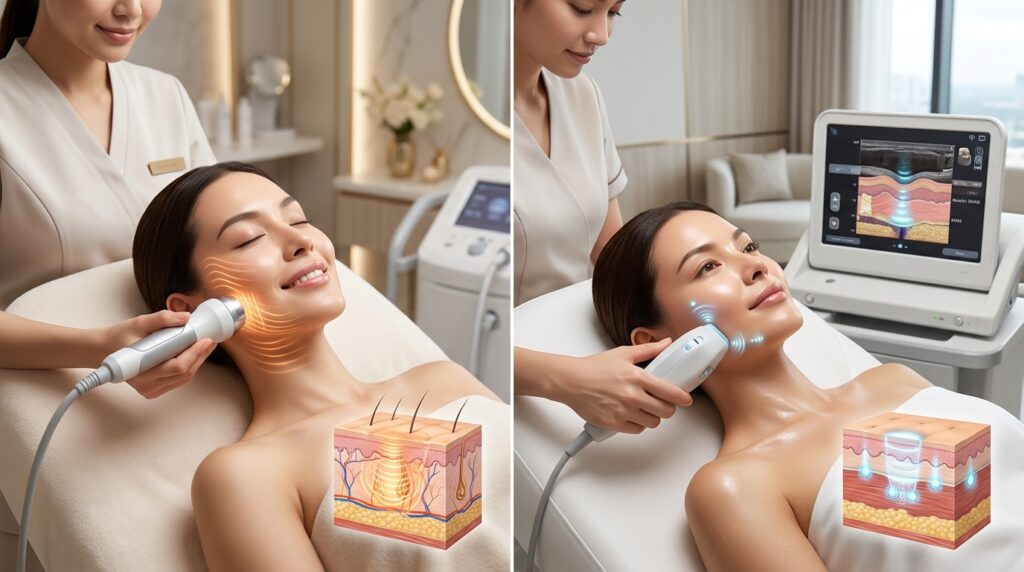
The aesthetic medicine landscape has never offered more options for men and women who want to turn back the clock without going under the knife. At the top of that list, consistently, year after year, sit two technologies that have genuinely changed what non-surgical skin tightening can achieve: Thermage and Ultherapy.
If you’ve been researching a non-surgical facelift, chances are you’ve already encountered both names. Maybe you’ve read conflicting reviews. Maybe your friend swears by one while your aesthetician recommends the other. Maybe you’re simply not sure what either actually does inside your skin, and you want a clear, medically honest answer before you commit to a treatment or spend thousands of dollars.
That’s exactly what this guide is for.
At Tatoyan MD Medspa, our board-certified physicians have extensive experience administering both Thermage and Ultherapy, and more importantly, evaluating patients carefully to determine which technology (or combination of both) will deliver the best possible outcome for each individual. We’ve written this comprehensive breakdown to give you the clinical clarity you deserve.
Let’s get into it.
What Is Non-Surgical Skin Tightening, and Why Does It Work?
Before diving into the Thermage vs Ultherapy comparison, it’s worth understanding the shared biological principle that makes both treatments effective: controlled thermal injury and collagen remodeling.
As we age, our skin’s structural proteins, primarily collagen and elastin, gradually break down. Collagen provides the scaffolding that keeps skin firm and lifted. Elastin gives skin its ability to snap back into shape. According to research published through the National Institutes of Health (NIH), collagen production in human skin declines at approximately 1% per year beginning in our mid-20s. By the time most people are in their 40s and 50s, that cumulative loss is visible as skin laxity, jowling, deepened nasolabial folds, and a general softening of facial contours.
Both Thermage and Ultherapy address this by delivering precisely controlled thermal energy deep into the skin and underlying tissues, triggering the body’s natural wound-healing response and stimulating the production of new, healthy collagen. The difference lies in how they deliver that energy, how deep that energy reaches, and what structures each technology is best positioned to treat.
Understanding these differences is the key to understanding the entire Thermage vs Ultherapy debate.

What Is Thermage?
How Radiofrequency Skin Tightening Works
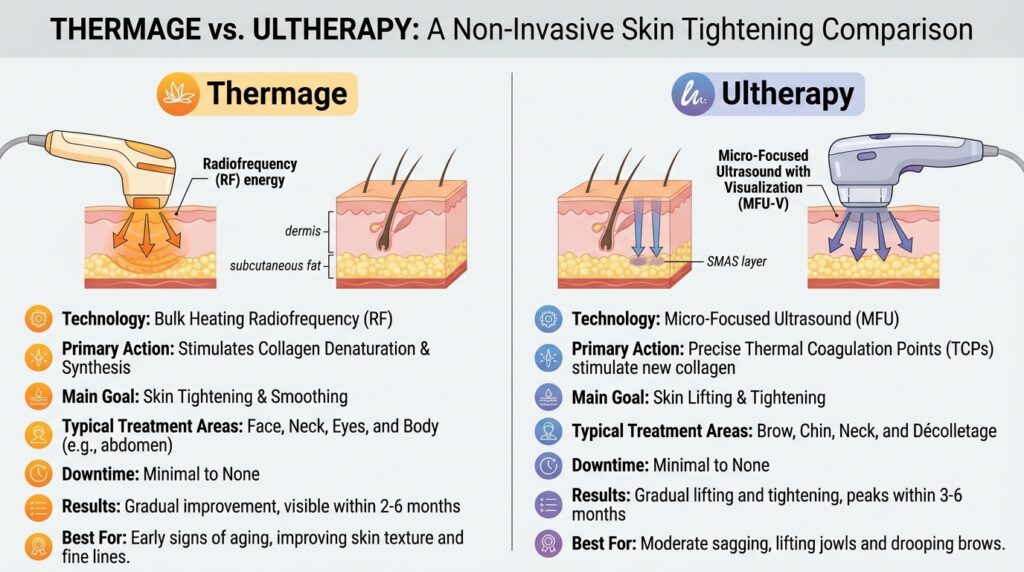
Thermage is a non-invasive radiofrequency (RF) skin tightening treatment that uses monopolar radiofrequency energy to heat the deep dermis and subcutaneous tissue. It was cleared by the U.S. Food and Drug Administration for non-invasive treatment of wrinkles and skin laxity, and has been in clinical use for over two decades, one of the most established non-surgical skin tightening platforms in aesthetic medicine.
The Science Behind Thermage RF Treatment
The Thermage device delivers RF energy through a treatment tip that is moved across the surface of the skin in a stamping pattern. The energy penetrates into the dermis, the deeper layer of the skin where collagen lives, and heats the tissue to therapeutic temperatures (typically between 65°C and 75°C). At these temperatures, two critical events occur:
- Immediate collagen contraction: The heat causes existing collagen fibers to contract and tighten, producing a degree of visible lifting that can be apparent immediately after the treatment session.
- Neocollagenesis: The controlled thermal injury triggers the body’s healing cascade, stimulating fibroblast activity and the production of new collagen over the following 3–6 months.
The current generation device, Thermage FLX, features a larger treatment tip, an improved comfort pulsing system, and AccuREP technology that automatically adjusts energy delivery in real time for more consistent, safer results compared to earlier generations.
What Areas Can Thermage Treat?
One of Thermage’s significant advantages is its versatility. It can be used effectively on:
- The face, jowls, jawline definition, nasolabial folds, under-eye crepiness, brow lifting
- The neck, tightening loose, sagging skin and reducing horizontal neck bands
- The body, abdomen, inner thighs, arms, knees, and buttocks where skin laxity is a concern
- The eyes, a specialized tip is cleared specifically for upper and lower eyelid tightening, making Thermage one of the few energy devices safe for periorbital use
This body-wide applicability makes Thermage a particularly powerful tool in comprehensive rejuvenation planning.
What to Expect During and After a Thermage Treatment
A Thermage treatment is performed in a single session, typically lasting 45–90 minutes depending on the treatment area. Most patients describe the sensation as intermittent pulses of deep warmth followed by cooling, manageable with the device’s built-in cooling system, though the level of comfort varies between individuals and providers.
- Downtime: Minimal to none. Most patients return to normal activities the same day, with possible mild redness that resolves within hours.
- Immediate results: A subtle tightening effect is often visible immediately post-treatment due to initial collagen contraction.
- Progressive results: The primary improvement develops over 3–6 months as new collagen forms, with results lasting 1–2 years or longer with proper skin care and maintenance.
- Sessions needed: Typically a single treatment per area per year, which is one of Thermage’s most significant practical advantages.

What Is Ultherapy? How Ultrasound Skin Lifting Works
Ultherapy is the only non-invasive treatment cleared by the U.S. Food and Drug Administration (FDA) specifically for lifting the skin of the brow, chin, neck, and décolletage, a distinction that matters enormously in the Thermage vs Ultherapy conversation. It uses micro-focused ultrasound with visualization (MFU-V) to deliver precise thermal energy at specific, targetable depths beneath the skin surface.
The Science Behind Ultherapy Ultrasound Lifting
What makes Ultherapy genuinely unique among non-surgical skin tightening technologies is its ability to visualize the tissue layers in real time while delivering treatment. Using the same ultrasound imaging principles as diagnostic medical ultrasound, Ultherapy’s handpiece lets the treating physician see exactly what lies beneath the surface of the skin, including the thickness of the dermis, the depth of subcutaneous fat, and critically, the location of the SMAS (Superficial Musculo-Aponeurotic System).
The SMAS is the same fibromuscular layer that surgeons address during a traditional surgical facelift. It is the structural foundation of facial support. The fact that Ultherapy can target and thermally stimulate the SMAS layer, at depths of 4.5mm and beyond, without any incisions is what earns it the “non-surgical facelift” designation more than any other technology currently available.
Ultherapy creates small, precisely placed thermal coagulation points (TCPs) at three key depths:
- 1.5mm, superficial dermis
- 3.0mm, deep dermis
- 4.5mm, the SMAS layer
Each TCP triggers a focused heating event that contracts tissue immediately and initiates collagen neogenesis over the following months.
What Areas Does Ultherapy Target?
Ultherapy’s FDA clearances are specifically for:
- Brow lifting, elevating a descended or heavy brow for a more open, refreshed eye appearance
- Chin and jawline tightening, improving jowling and redefining the lower face
- Neck tightening, reducing laxity and banding in the anterior and lateral neck
- Décolletage, smoothing crepiness and lines in the chest area
Off-label, Ultherapy is also commonly used on the mid-face, nasolabial folds, and periorbital area by experienced practitioners.
What to Expect During and After Ultherapy
Ultherapy treatments are performed in a single session lasting 60–90 minutes, depending on the areas being treated. It is important to set honest expectations about comfort: Ultherapy is generally considered more intense than Thermage during the procedure. The focused ultrasound pulses are felt as brief, sharp sensations of deep heat, particularly over bony prominences. At Tatoyan MD Medspa, we use topical anesthesia and, where appropriate, oral premedication to maximize patient comfort.
- Downtime: Minimal. Mild redness, swelling, and tenderness for 24–48 hours is typical. Rarely, temporary nerve sensitivity or bruising can occur.
- Immediate results: Some patients notice a subtle initial effect, but the primary lifting response develops gradually.
- Progressive results: The most significant results emerge at 3–6 months, continuing to improve through 6–12 months post-treatment.
- Sessions needed: Most patients achieve their desired outcome with a single annual treatment, though some with more advanced laxity benefit from two sessions spaced 6 months apart.
Thermage vs Ultherapy: The Direct Comparison
Now that we understand how each technology works, let’s put them side by side across the dimensions that matter most to patients considering a non-surgical facelift.
Energy Type and Depth of Treatment
This is the most fundamental difference in the Thermage vs Ultherapy debate:
- Thermage uses radiofrequency energy, which heats tissue through electrical resistance. It targets the dermis and upper subcutaneous tissue, typically reaching depths of 2–3mm in facial applications, with body treatments reaching somewhat deeper.
- Ultherapy uses micro-focused ultrasound, which can focus thermal energy at precise, targeted depths of 1.5mm, 3.0mm, and 4.5mm, reaching all the way to the SMAS layer that RF energy cannot consistently access.
Clinical implication: For patients whose primary concern is skin texture improvement, surface-level tightening, and moderate laxity, Thermage’s dermal heating is highly effective. For patients with more significant laxity who want meaningful lifting, particularly of the brow, jawline, and neck, Ultherapy’s deeper SMAS-level targeting gives it a structural advantage.
Treatment Comfort
Both treatments involve some degree of discomfort, and it’s important to be honest about this:
- Thermage FLX is generally considered the more comfortable of the two, thanks to its vibrating comfort tip and real-time cooling system. Most patients tolerate it well with minimal or no anesthesia.
- Ultherapy is more intense, with sharp pulsing sensations particularly noticeable over bony areas of the face and neck. Experienced providers use topical numbing agents and may offer oral pain relief for patient comfort.
Neither treatment is painless, but both are very manageable with proper preparation and an experienced provider.
Results: Tightening vs Lifting
- Thermage excels at tightening and smoothing, improving skin texture, reducing fine lines, and creating a firmer skin surface. Results are particularly impressive for crepey skin on the eyelids, jawline softening, and body skin laxity.
- Ultherapy excels at lifting and repositioning, physically elevating descended tissue, redefining facial contours, and providing structural improvement that goes beyond what surface tightening alone can achieve.
The distinction between tightening and lifting is subtle but clinically important. Tightening improves the quality and firmness of the skin itself. Lifting addresses the position of underlying tissue and restores a more youthful facial architecture.
Treatment Areas
| Treatment Area | Thermage | Ultherapy |
| Face (general) | Excellent | Excellent |
| Brow lifting | Moderate | Superior (FDA cleared) |
| Jawline / Jowls | Good | Excellent |
| Neck | Good | Superior (FDA cleared) |
| Eyelids (upper/lower) | FDA cleared tip available | Used with caution off-label |
| Décolletage | Good | FDA cleared |
| Body (abdomen, thighs, arms) | Excellent | ❌ Not indicated |
Downtime and Recovery
Both treatments are genuinely non-surgical with no recovery time required in the traditional sense:
- Thermage: Most patients experience mild redness for a few hours. Return to work and normal activities the same day is typical.
- Ultherapy: Slightly more post-treatment sensitivity, with redness, swelling, and tenderness possible for 24–48 hours. Make-up can typically be applied the next day.
Neither treatment involves incisions, anesthesia, or a recovery period that disrupts daily life, which is precisely what makes them so appealing as non-surgical facelift alternatives.
Cost Considerations
Both treatments represent a meaningful financial investment, reflecting the clinical technology and expertise involved:
- Thermage FLX typically ranges from $2,000 to $4,500 for a full-face treatment, depending on geographic location, practice, and the extent of the treatment area.
- Ultherapy typically ranges from $2,500 to $5,000 for a full face and neck protocol, with pricing varying by the number of lines (energy delivery points) and areas treated.
Body Thermage treatments may add to the overall cost depending on what is addressed. Consultation with your provider is essential for accurate pricing.
Longevity of Results
- Thermage: Results typically last 1–2 years, with annual maintenance treatments helping to sustain and build on improvements over time.
- Ultherapy: Results generally last 12–18 months, though this varies based on individual skin biology, the degree of initial laxity, and lifestyle factors (sun exposure, smoking, weight fluctuation).
Both treatments benefit from a comprehensive at-home skincare routine, including a medical-grade SPF, retinol or retinoid, vitamin C serum, and peptide-based moisturizers, which helps protect and extend the collagen-stimulating results achieved in the treatment room.
Read more: Ultherapy vs Morpheus8
Who Is the Best Candidate for Thermage vs Ultherapy?
This is the question our physicians at Tatoyan MD Medspa evaluate in every consultation. The technology is only as powerful as the appropriateness of its application.
Ideal Candidates for Thermage
- Men and women in their 30s to 60s with mild to moderate skin laxity
- Patients whose primary concern is skin texture, crepiness, or surface quality, including eyelid hooding, fine lines, and mild jowling
- Patients wanting body skin tightening (abdomen, inner thighs, arms, knees), a use case where Thermage has significant advantages over Ultherapy
- Patients with lower pain tolerance who prefer a more comfortable treatment experience
- Patients who want to address multiple areas in a single session, including body areas
- Those seeking annual single-session maintenance without repeated treatments through the year
Ideal Candidates for Ultherapy
- Men and women in their 35s to 65s with mild to moderate facial and neck laxity who want visible lifting, not just tightening
- Patients with a descended brow, early jowling, or a softened jawline who want architectural repositioning of facial tissue
- Patients who have had previous Thermage treatments and want to add a deeper structural dimension to their results
- Those concerned about neck laxity and banding and want the specific FDA-cleared lifting indication that Ultherapy provides
- Patients whose real-time imaging reveals sufficient SMAS thickness to support effective SMAS-level treatment
Patients Who May Benefit From Both
Increasingly, the most sophisticated non-surgical rejuvenation protocols combine both Thermage and Ultherapy, using Ultherapy’s deep SMAS lifting and Thermage’s superior dermal tightening and surface quality improvement in a complementary, layered approach. At Tatoyan MD Medspa, we frequently design combination protocols for patients who want comprehensive rejuvenation that addresses multiple tissue depths simultaneously.
Clinical Insight from Tatoyan MD Medspa: The single biggest mistake patients make when choosing between Thermage and Ultherapy is choosing based on price or a friend’s recommendation without a professional evaluation. Skin thickness, tissue depth, the degree and location of laxity, and your individual anatomy all determine which technology will work best for you, and an experienced physician’s assessment is the only way to know for certain.
Thermage vs Ultherapy: What Does the Clinical Evidence Say?
Both technologies are supported by peer-reviewed clinical literature, and understanding the evidence landscape is part of making an informed decision.
Thermage has been studied extensively over its two-decade clinical history. Multiple controlled studies have demonstrated statistically significant improvements in skin laxity scores, collagen density (measured by biopsy and imaging), and patient satisfaction scores following treatment. The transition to the FLX platform has been associated with improved consistency and comfort versus earlier generations.
Ultherapy holds a particularly strong evidence base given its FDA clearances, which required submission of clinical data demonstrating both safety and efficacy for lifting indications. Published studies confirm measurable brow elevation, improved jawline definition, and patient satisfaction rates consistently above 70–80% in well-selected candidates. Research published through PubMed supports Ultherapy’s SMAS-depth collagen stimulation and its mechanism of action as distinct from and complementary to radiofrequency-based technologies.
Both technologies continue to evolve. Next-generation platforms, improved transducer technology (for Ultherapy), and refined treatment protocols are pushing outcomes beyond what was achievable even five years ago.
How Tatoyan MD Medspa Approaches the Thermage vs Ultherapy Decision
At Tatoyan MD Medspa, we do not have a single default recommendation. We believe the best non-surgical facelift outcome comes from a genuinely individualized approach, not a templated treatment menu.
Here is how our consultation process works:
Step 1: Comprehensive Skin and Tissue Assessment
Every new patient consultation begins with a thorough evaluation of the skin’s surface quality, elasticity, and degree of laxity, using both visual assessment and, where indicated, ultrasound imaging of tissue depth. We assess the specific areas of concern: brow position, mid-face volume, jawline definition, neck laxity, and overall skin quality.
Step 2: Understanding Your Goals and Priorities
We ask detailed questions about what bothers you most, what kind of result you’re hoping to achieve, your tolerance for discomfort, your schedule, and your budget. A patient who is primarily concerned about crepey eyelid skin has a different priority than one who is bothered by jowling and a heavy brow, and those different priorities may point toward different technologies.
Step 3: Reviewing Your Full Aesthetic History
We review any previous treatments, including neurotoxins, dermal fillers, prior energy-based treatments, and any surgical procedures. Understanding what has been done before, and how you responded, informs what we recommend next.
Step 4: Building Your Personalized Protocol
Based on all of the above, we design a protocol that may include Thermage, Ultherapy, or a combination of both, along with complementary treatments such as neurotoxin for dynamic lines, dermal filler for volume restoration, and medical-grade skincare to support and extend your results.
We also discuss realistic timelines, what you will look like immediately after treatment, when to expect your peak results, and how to plan maintenance going forward.
Skincare to Maximize Your Non-Surgical Facelift Results
Whether you choose Thermage, Ultherapy, or both, your at-home skincare routine plays a meaningful role in the quality and longevity of your results. The collagen-stimulating response triggered by both technologies is supported, or undermined, by what you do with your skin every day.
Non-Negotiable Daily Habits
- Broad-spectrum SPF 30–50: UV exposure is the single greatest accelerant of collagen breakdown. Daily sunscreen use, even on cloudy days and indoors near windows, is essential to protecting and extending your investment in any collagen-stimulating treatment.
- Medical-grade retinol or prescription retinoid: Retinoids are the most extensively evidence-supported topical ingredient for stimulating fibroblast activity and collagen production. Used consistently, they compound the collagen-building effects of both Thermage and Ultherapy.
- Vitamin C serum (L-ascorbic acid): A potent antioxidant that also directly supports collagen synthesis, apply in the morning under SPF for maximum benefit.
- Peptide-rich moisturizer: Peptides signal fibroblasts to produce collagen and support the skin barrier. Look for formulations containing palmitoyl tripeptide-1, palmitoyl tetrapeptide-7, or matrixyl synthe’6.
- Adequate hydration: Hyaluronic acid-based serums improve skin plumpness and surface quality, supporting the firming effects of your treatment.
At Tatoyan MD Medspa, we prescribe individualized medical-grade skincare regimens for every patient undergoing energy-based treatment. Our physicians assess your current routine, identify gaps, and recommend clinical-strength formulations that are meaningfully more potent than over-the-counter alternatives.
Thermage vs Ultherapy vs Surgical Facelift: Setting Realistic Expectations
One of the most important services we can provide our patients is honest expectation-setting, and that means being clear about what non-surgical technologies can and cannot achieve compared to surgery.
Both Thermage and Ultherapy are genuinely effective for the right candidates. But they are not surgical facelifts, and they should not be presented or positioned as equivalent to surgery for patients with significant laxity.
A traditional surgical facelift (rhytidectomy) physically repositions and removes excess skin, addresses deep structural changes, and can produce dramatic, lasting results that no non-surgical technology currently matches for advanced facial aging. According to the American Society of Plastic Surgeons, facelift surgery remains the gold standard for significant facial rejuvenation in patients with moderate to severe laxity.
The sweet spot for Thermage and Ultherapy, individually and especially in combination, is the patient who:
- Has mild to moderate skin laxity and does not yet require surgical intervention
- Wants to delay the need for surgery by maintaining skin quality and structural support over time
- Has already had surgery and wants non-surgical maintenance to extend their surgical results
- Prefers a non-surgical approach for personal or medical reasons and has realistic expectations about the degree of improvement achievable
Being honest about this is a core value at Tatoyan MD Medspa. We will always tell you when a non-surgical approach is likely to meet your goals, and when it may not be the right tool for the job.
Frequently Asked Questions About Thermage vs Ultherapy
1. What is the main difference between Thermage and Ultherapy?
The primary difference between Thermage vs Ultherapy lies in the energy technology used and the depth of tissue targeted. Thermage uses monopolar radiofrequency (RF) energy to heat the dermis and upper subcutaneous tissue, producing skin tightening and collagen stimulation. Ultherapy uses micro-focused ultrasound to deliver precise thermal energy at multiple targeted depths, including the SMAS layer at 4.5mm, which is the same deep tissue plane addressed in a surgical facelift. Thermage excels at skin quality improvement and surface tightening across the face and body. Ultherapy excels at structural lifting of the brow, jawline, and neck. Many patients benefit from combining both technologies for comprehensive results at multiple tissue depths.
2. Which treatment is more painful, Thermage or Ultherapy?
Generally speaking, Ultherapy is considered more uncomfortable than Thermage. The focused ultrasound pulses create brief, intense sensations of deep heat, particularly over bony areas like the jawline and brow ridge. Thermage FLX, with its vibrating comfort tip and simultaneous cooling, is tolerated more easily by most patients and often requires minimal or no anesthesia. At Tatoyan MD Medspa, we use topical numbing agents and offer oral premedication for Ultherapy patients to maximize comfort. Neither treatment is unbearable, but honest communication about expected sensations is something we prioritize in every consultation.
3. How long do Thermage and Ultherapy results last?
Both treatments produce results that last approximately 12–18 months for most patients, though individual variation is significant. Thermage results often maintain well for 1–2 years, while Ultherapy’s lifting effects are typically assessed at 12–18 months. Longevity depends on the individual’s rate of collagen loss, lifestyle factors (sun exposure, smoking, weight changes), and how consistently a supportive medical-grade skincare routine is maintained. Annual maintenance treatments with either technology help sustain and build on initial improvements over time. At Tatoyan MD Medspa, we design long-term maintenance plans for every patient to protect their investment and optimize ongoing results.
4. Can Thermage and Ultherapy be done together?
Yes, and in fact, combining Thermage and Ultherapy is an increasingly popular approach for patients who want the most comprehensive non-surgical rejuvenation outcome. Ultherapy’s deep SMAS-level lifting and Thermage’s superior dermal tightening and skin surface improvement are genuinely complementary, addressing different tissue depths and different aspects of facial aging in a single comprehensive protocol. Some providers perform both treatments in the same session; others prefer to space them apart. At Tatoyan MD Medspa, we evaluate each patient individually to determine whether simultaneous or sequential combination treatment is most appropriate for their anatomy, goals, and tolerance.
5. Am I a good candidate for a non-surgical facelift with Thermage or Ultherapy?
The ideal candidate for either technology is a man or woman with mild to moderate skin laxity who wants to improve facial firmness and contour without surgery. Patients with very early signs of aging, primarily seeking prevention and maintenance, as well as those in their 30s, 40s, and 50s who are noticing early jowling, brow descent, neck laxity, or skin quality changes tend to be the most satisfied. Patients with severe laxity or significantly descended tissue may not achieve adequate improvement with non-surgical technologies and may be better served by surgical consultation. The only reliable way to determine candidacy is a thorough in-person evaluation with a qualified medical professional. We offer personalized consultations at Tatoyan MD Medspa specifically designed to answer this question for every individual patient.
The Bottom Line: Thermage vs Ultherapy, Which Is Right for You?
If there is one thing this guide should leave you with, it’s this: the Thermage vs Ultherapy question does not have a one-size-fits-all answer, and anyone who tells you it does is either oversimplifying or trying to sell you something.
Choose Thermage if your primary concerns are skin texture, surface crepiness, eyelid tightening, or body skin laxity, or if you want a more comfortable single-session treatment with a strong track record of tightening results.
Choose Ultherapy if your primary concerns are visible lifting, a heavier brow, early jowling, jawline softening, or neck laxity, and you want a technology that reaches the structural SMAS layer that drives meaningful facial repositioning.
Consider both if you want the most comprehensive non-surgical rejuvenation possible, addressing multiple tissue depths and multiple aspects of facial aging simultaneously.
And above all else, consult with a board-certified physician who has genuine expertise with both technologies, takes the time to understand your specific anatomy and goals, and will give you an honest recommendation even if it’s not what you expected to hear.
That is precisely what we do at Tatoyan MD Medspa.
Book your personalized Thermage vs Ultherapy consultation at Tatoyan MD Medspa →
Our medical team will evaluate your skin, discuss your goals, and design the right non-surgical skin tightening protocol for you, with the clinical transparency and expertise you deserve.